
An increasing problem
Traditionally in our UK climate with MVHR the main concern has been how it can maintain good ventilation levels, and therefore air quality, but without creating a heat loss in winter.
With the increase in frequency and severity of the heatwaves we have been experiencing in the UK there has been a shift in general to thinking about cooling and with that how MVHR interacts with overheating in buildings.
MVHR works both ways
The good news is that even though we usually think of MVHR as a way of keeping heat inside in winter it also does the opposite by keeping heat out in summer.
In winter you still need a heating system to add heat to the building to counteract heat losses. In the same way in summer if there is prolonged periods of hot weather the building will need heat removing from it by an active cooling system or the temperatures will increase.
MVHR maintains good levels of ventilation without the heat losses in winter and heat gains in summer caused by natural / uncontrolled ventilation but does not add or remove heat like an active system.
Active Cooling
Generally in the UK, and certainly the further north you go, the lack of active cooling hasn’t been too much of an issue as in a well-insulated airtight building with MVHR the heat could be kept out to a certain extent during the day and then night time purging used later to get rid of the excess heat to maintain a bearable temperature. Also the frequency and duration of this overheating wasn’t too hard to deal with.
However with a warming planet the temperatures of these heatwaves have increased and temperatures are often not dropping enough at night for night purging to have enough of an affect before temperatures rise the next day.
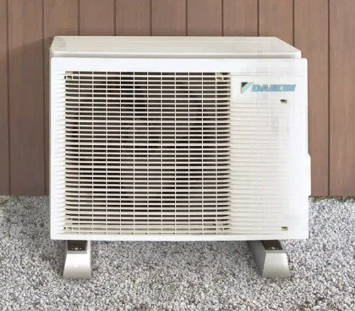
Therefore it is inevitable that more buildings in the UK will need active cooling and the good news is MVHR will work really well alongside this. When the cooling system is operating the MVHR heat exchanger will recover that ‘coolth’, from the extract air to the supply air, keeping it inside and the heat outside.
Active cooling has often been viewed as high energy consumption ‘nice to have’ but as long as overheating risk has been minimised by using as many other measures as possible (see the Solar Gains section below) and taking advantage of MVHR to recover as much of the cool created, the amount of energy can be kept as low as possible.
Also by combining AC with Solar PV the impact can be kept low and as AC systems can usually do heating as well (remember it’s just a heat pump) this could be a way of reducing fossil fuel use in winter.
AC is not ventilation
But, remember active cooling / AC systems only recirculate air which is why they are good at cooling a space quickly but you still need MVHR to provide the fresh air and get rid of stale air alongside AC.
The Bypass
MVHR units also help with purging heat by opening a bypass to allow the incoming air to skip the heat exchanger and be supplied straight into the house (still via particulate filters). This will help bring the temperature down after a hot day (assuming outdoor temperatures drop sufficiently). This is especially useful in buildings where opening the windows is not practical because of security, noise or polluted outdoor air reasons.
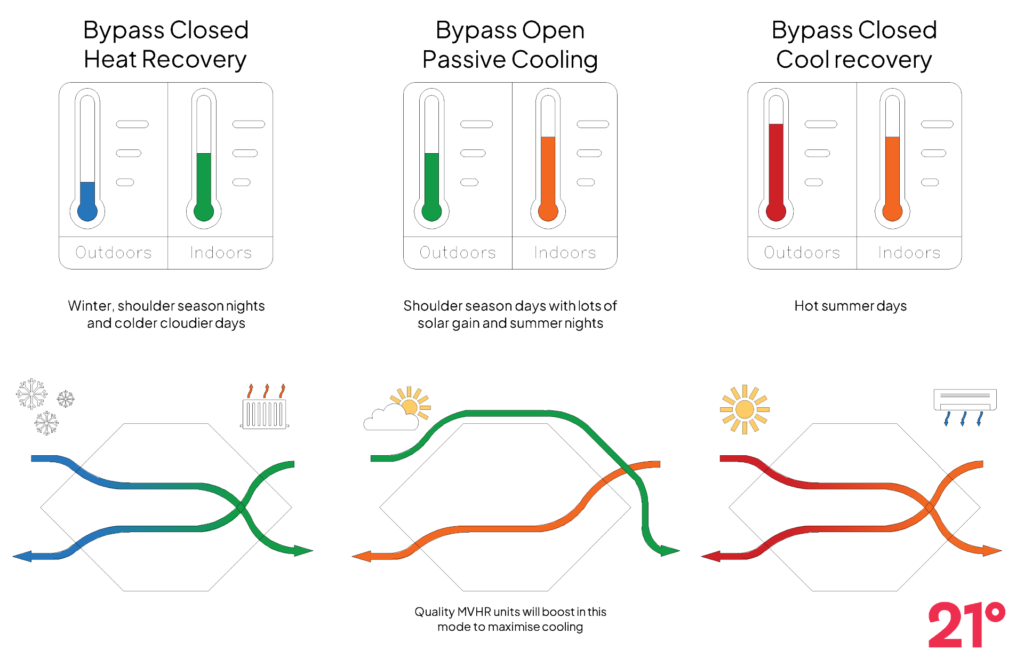
Good MVHR units will also detect if it is useful to boost up their airflow, when the bypass is open, to get as much of this cooler air in as possible. This is also the reason we would recommend having your intake on the north side of the building where surfaces around it will be shaded from direct sunlight.
Solar Gains
What makes summer heat gains different to winter heat losses is the additional element of solar gains from areas of glazing.
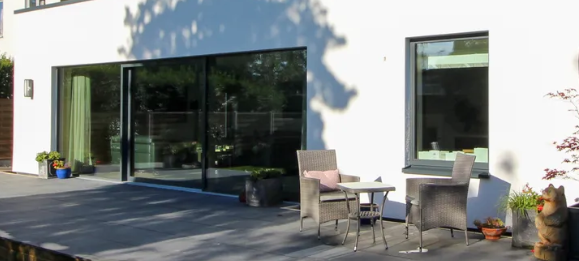
The first thing that should be done in any house experiencing overheating is to deal with these.
In a house at design stage this can be done by thinking about window orientations, sizes, overhangs, trees etc but for an existing building the addition of external shading and blinds can have a huge impact to reduce overheating.
For a summary of some of the different shading options see this this article.
Summary
So the main point is MVHR is doing all it can to maintain your indoor air quality while contributing a little as possible to overheating BUT it isn’t an active cooling system sometimes active cooling will be required but passive purging and shading options should all be exhausted first.
Active cooling via MVHR
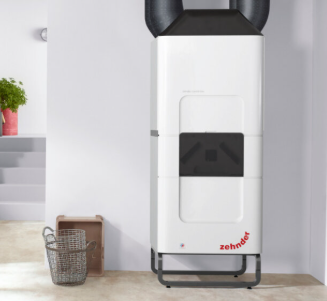
There are solutions that can provide active cooling via the MVHR supply air but there limitations to these and many considerations when working out if this is appropriate for your building. We cover these in this article.